Christopher Nolan has never been a filmmaker afraid of scale. Whether exploring dreams, space travel, or the invention of the atomic bomb, his films have consistently grappled with ideas and images that feel larger than life. With The Odyssey, he turns his attention to perhaps the greatest epic ever written, adapting Homer’s timeless poem into a sweeping cinematic experience that feels perfectly suited to his filmmaking sensibilities. Few stories have had a greater influence on literature than The Odyssey, whose themes of perseverance, homecoming, temptation, and identity have echoed through storytelling for nearly three thousand years. Few directors working today possess both the ambition and technical mastery to bring a tale of this magnitude to the screen, and Nolan proves once again why he remains one of modern cinema’s premier blockbuster auteurs with a once-in-a-lifetime cinematic experience.
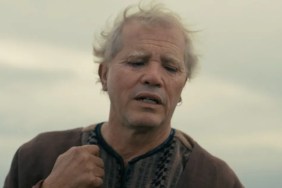
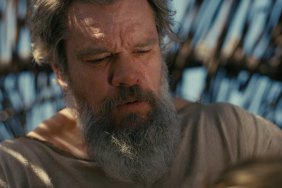
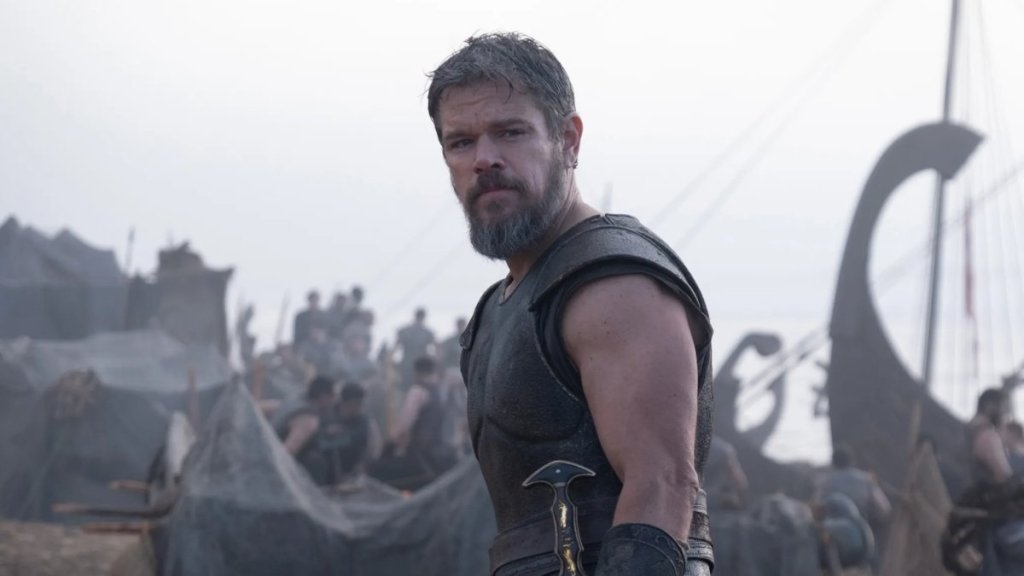
At the center of the film is Matt Damon as Odysseus, a role that almost feels like a clever wink to audiences familiar with the actor’s career. For decades, Damon has become something of a cinematic symbol for characters desperately trying to find their way home, whether in Saving Private Ryan, Interstellar, or The Martian. Here, that recurring theme reaches its most literal form. Much of the emotional tension throughout The Odyssey revolves around a single question: will Odysseus ever return home, and what must he sacrifice to get there? Damon carries that burden convincingly, portraying a man whose legendary reputation often overshadows the deeply human longing driving every decision he makes.
Interestingly, Nolan doesn’t immediately present Odysseus as the film’s central figure. Instead, the audience spends much of the opening act learning about him through the perspectives of others. For a considerable stretch, the story feels anchored by his son, Telemachus, played by Tom Holland. Holland has always demonstrated remarkable dramatic ability beyond his blockbuster credentials, and The Odyssey gives him some of his strongest material yet. His performance captures both the uncertainty of a son searching for answers and the determination to uncover the truth about the father he barely knows.
Nolan structures the film in his signature non-linear fashion, relying heavily on flashbacks to gradually assemble Odysseus’ journey. In the hands of a lesser filmmaker, this approach could easily have become exhausting or overly reliant on exposition. Instead, Nolan’s confidence with fractured storytelling allows each revelation to enrich what came before, rewarding audiences as the timeline slowly falls into place. That said, the structure isn’t without its drawbacks. Because the narrative frequently shifts among different characters’ perspectives and points in time, some sections can feel disconnected. Rather than unfolding like one continuous adventure, the film sometimes resembles a collection of interconnected stories passed down through generations.
That episodic quality is understandable given the source material, but it does result in certain sequences feeling more consequential than others. The encounter with the Cyclops stands as one of the film’s standout episodes, capturing both the terror and ingenuity that define Odysseus’ legend. Samantha Morton also delivers a wonderfully committed performance in a memorable sequence that showcases her tremendous screen presence, even if that portion of the story ultimately doesn’t feel as essential to the larger narrative. Similarly, storylines involving Lupita Nyong’o and Jon Bernthal feature strong performances but occasionally feel like detours away from the film’s emotional core surrounding Odysseus’ return home.
Among the film’s greatest achievements is the realization of iconic moments from Greek mythology with such cinematic ambition. The Trojan Horse sequence is easily one of the movie’s highlights. Watching the Greek soldiers conceal themselves within the massive wooden horse before emerging to launch their attack is breathtaking, and Nolan stages the sequence with remarkable tension and precision. It’s exactly the kind of legendary moment audiences hope to see handled by one of cinema’s greatest directors, and he more than delivers.
The production itself is equally astounding. Nolan’s commitment to practical filmmaking remains unmatched, and The Odyssey frequently leaves viewers wondering how many of its most ambitious sequences were even possible to accomplish. Extended scenes aboard ships battling unforgiving seas possess an authenticity rarely found in modern blockbusters. The crashing waves, soaked actors, and relentless physicality give the adventure a tactile realism that’s impossible to fake.
Perhaps the film’s greatest technical accomplishment is that it is the first feature shot entirely on 70mm IMAX cameras. While many modern blockbusters alternate between standard widescreen photography and expanded IMAX sequences, The Odyssey maintains its towering aspect ratio from beginning to end. The result is unlike anything audiences have experienced before. Every frame feels immense, immersing viewers in landscapes, oceans, and battles with breathtaking scale. It’s easy to understand why 70mm IMAX screenings have become such sought-after events. This is exactly the kind of movie that justifies seeing it on the biggest screen possible.
The ensemble cast is predictably stacked with talent. Anne Hathaway brings genuine emotional weight to Penelope, grounding the story with a quiet longing that mirrors Odysseus’ own journey. John Leguizamo is also a welcome surprise, delivering a refreshingly dramatic performance against type. Robert Pattinson, meanwhile, continues to prove his remarkable versatility. While audiences know he can effortlessly play heroic figures like Cedric Diggory and Batman, he thrives when portraying deeply unpleasant characters. His performance as Antinous is thoroughly detestable, making him an immensely satisfying antagonist.
Zendaya’s Athena initially feels somewhat reminiscent of her role in Dune: Part One, appearing primarily as a guiding presence whenever the protagonist requires direction. Fortunately, Nolan takes her character in a more rewarding direction during the film’s final act, where her presence gains significantly greater emotional and narrative importance.
That final act ultimately elevates the entire film. While everything leading up to it is consistently engaging, the conclusion raises both the emotional stakes and the action to another level. The choreography during the climactic confrontations is exceptional, even if Nolan occasionally frames the action slightly too close, making certain moments harder to fully appreciate. Likewise, the film embraces the modern tendency toward extremely shallow depth of field, and there are occasional shots where the focus visibly struggles to keep pace with the performers.
Those minor issues hardly diminish what is otherwise a stunning visual achievement. Hoyte van Hoytema’s breathtaking cinematography once again demonstrates why his collaboration with Nolan has become one of contemporary cinema’s greatest creative partnerships, while Ludwig Göransson’s soaring score perfectly complements the film’s sense of mythic grandeur.
Like other Christopher Nolan films, The Odyssey isn’t flawless. He’s made a few movies I’d consider perfect, and while this isn’t one, it comes quite close. Some storylines feel more essential than others, and its ambitious narrative occasionally creates rough edges. Yet those imperfections become almost irrelevant when viewed within the context of the experience Nolan has crafted. This is filmmaking on a scale few directors even attempt, let alone achieve. Grand, emotional, visually staggering, and relentlessly immersive, The Odyssey delivers the kind of cinematic spectacle that reminds audiences why movies are meant to be experienced in theaters. It is an extraordinary achievement that deserves to be seen on the biggest screen possible.
SCORE: 8/10
As ComingSoon’s review policy explains, a score of 8 equates to “Great.” While there are a few minor issues, this score means that the art succeeds at its goal and leaves a memorable impact.
Disclosure: ComingSoon attended an early screening for our The Odyssey review.