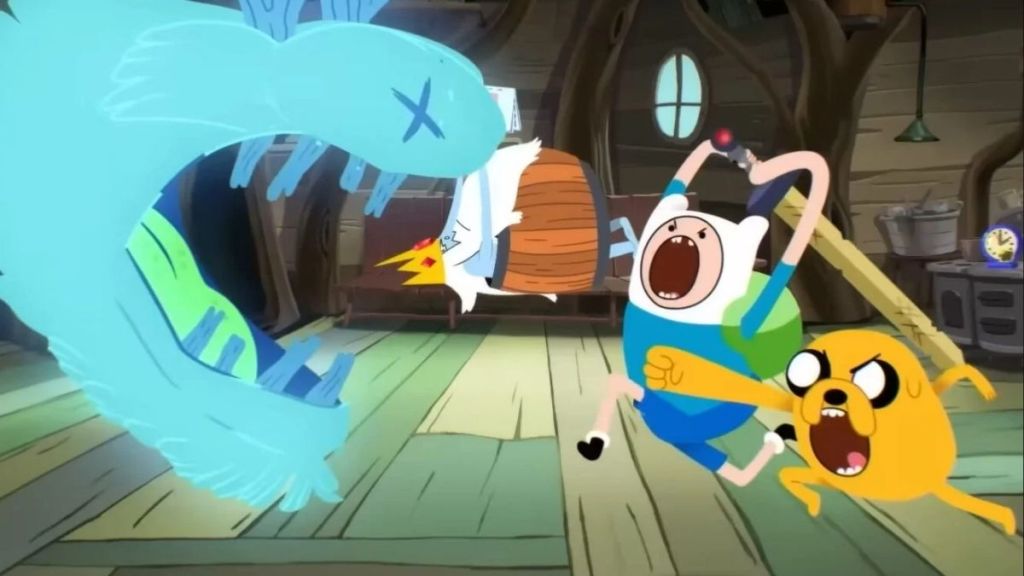
Adventure Time: Side Quests’ showrunner and executive producer Nate Cash, supervising director Victor Courtright, and art director Nick Cross spoke with ComingSoon about the new show. The trio discussed the show going back to basics, why it’s not actually a prequel, and more. It’s now streaming on Hulu and Disney+.
“Adventure Time: Side Quests builds on the spirit of the early seasons, delivering lighter, self-contained adventures. Designed to introduce a new generation of fans to the land of Ooo, whilst giving existing fans more of what they love, the series brings standalone, silly quests and playful challenges – celebrating the joyful chaos of Finn and Jake’s adventures,” says the official description.
Tyler Treese: Nate, obviously the characters are younger in this, but can you talk to me about the aim of this spin-off? Did you view this as a potential entry point to Adventure Time? The main series gets a lot of lore to it, and this kind of feels like a return to the basics, which I really liked because that’s when I watched the show, and I got a lot of those classic vibes from it.
Nate Cash: Yeah, that was definitely the goal, to return the character of Finn or just expand on when Finn was 12 years old. I think sometimes people say “prequel,” and I don’t think it’s that because that’s also just another aspect of building out lore. I just wanted this to feel like these episodes fit in between the cracks of Seasons 1 and 2. Returning Finn to a kid voice was really freeing, to have him be young and naive and brash and have that real childish voice in this very dangerous, weird world. It’s really fun for comedy.
Tyler Treese: Victor, Nate kind of touched on it, saying he didn’t want to be beholden to really focusing on expanding it as a prequel. Could you talk to me about how you guys approached continuity? There are such expectations with this series. Was it more just having fun, or how much were you looking toward continuity? If you had a good idea for a character, did you kind of just throw them in?
Victor Courtright: I think a lot of us making the show either worked on the original or were huge fans of the original, like myself. So we’re generally aware of the lore and all that kind of stuff and know that if we’re in this little time pocket, we probably shouldn’t get into certain things. It was pretty natural. Very rarely did something come up where we’d ask, “Would it make sense to do this or not?” Because we’re all so familiar with it, it was pretty liberating to spend time in this world and go see new places.
The joy of those early seasons literally comes from exploring this unexplored world, going to new places, meeting weird characters, and having adventures. Obviously, it’s a burden because you don’t want to screw it up, but everybody was so familiar with it that it just came naturally, and it was purely fun.
Tyler Treese: Nick, I was curious, how would you describe the art style for this show? It looks like a storybook. It’s a very fun tweak from the original aesthetic.
Nick Cross: That’s a good analogy. We kept the design integral to the show and then built on it. We asked ourselves, “How do we give it a different spin?” You couldn’t make it simpler because the original show had a very stripped-down, simple style. So we took it and made it a little more complicated, making it very painterly, almost like a fantasy novel.
Tyler Treese: Nate, I was curious, can you talk me through the decision to cast Sasha as the voice of young Finn rather than doing digital manipulation or anything like that? Obviously, the original voice actor is so great, but it’s probably hard to get back to that Season 1-type voice.
Cash: Yeah, it was a little bit of a moment of anxiety because all through development I was pitching, “Return to a kid voice. Recast Finn.” In my head, Jeremy Shada’s voice was Finn. Even before that, in the Nickelodeon short, it was Jeremy’s older brother who aged out of doing that. So I thought, “That’s going to be a really tricky casting.” Everything was going to pivot around that. We really just lucked out that Sasha is so amazing and kind of embodies the character. As a human, he’s such a sweet, earnest kid, but as an actor, he really brings it. Leaning into that as an actor is awesome.
Victor, I liked how the show isn’t afraid to bring back characters, but there are also a lot of new faces. Could you speak to the balance of not relying on nostalgia but also not being afraid to use it? I feel like you can really get into your head and want to stray away from it, but people do get a kick out of seeing these characters. How was it finding that balance?
Victor Courtright: I think it was great, and it just kind of happened pretty naturally. We do a whole bunch with beloved characters. We go to a lot of familiar locations, and it’s really fun to see those people and go to those places. But part of the joy is exploring new places. You can’t explore the same dungeon a hundred billion times. You’ve got to go to some new ones every once in a while.
I think the same can be said for characters. Meeting a new little goblin prince might be exactly the thing you need out of an episode. Similarly to the places we go, the characters we meet are both familiar and new and exciting.
We get some great looks into the love life of Ice King in this first batch of episodes, for sure. They’re very fun.
Nate Cash: It’s pretty unique to the series, too, that it is sweet. But also, that episode is Ice King meets someone online, and then she comes and dumps her child off for him to babysit. So it’s really sweet, but also has these complex emotions going on where the villain needs you to help him babysit the child of his new girlfriend.
Nick, should eagle-eyed fans be looking out for Easter eggs in the show? How was the visual approach to throwing in those little teases?
Nick Cross: I don’t think we threw too many in. There might be some here and there. I’m trying to think off the top of my head, but we didn’t specifically do that. In the original show there was a waving snail in every episode, but we didn’t really go there with that. So yeah, I’m not sure.
Courtright: Maybe this is a little too broad, but some of the artwork we go to is literally beautiful repaintings of drawings from the original series. Some backgrounds people might recognize are just gorgeously rendered in this new style.
Cross: Yeah, there might even be the exact same shot from the original show, just redone.
Nate, I saw Pendleton Ward wrote one of the episodes that I got to see. Can you speak to his involvement and how he helped the series?
Cash: Yeah. When I was developing the show, I was running it past him just to make sure he was cool with it and to see if there was anything he wanted to tweak. He was excited about doing it. Obviously, he returned to do the voice of Lumpy Space Princess, and he also returned to do a storyboard for us too. It was really cool to see Pen doing writing and storyboarding for these characters that he hadn’t worked on in so many years.
Courtright: For all of us who weren’t on the original show and were fans of it, working on this new crew, watching Penn pitch an Adventure Time board was mind-expanding. It was so fun and joyous. It was incredible seeing him do his take on the show live because, obviously, he gets it.
Thanks to Nate Cash, Nick Cross, and Victor Courtright for taking the time to talk about Adventure Time: Side Quests.