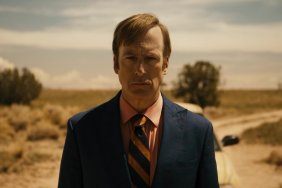
When Jimmy McGill (Bob Odenkirk) recalls his harrowing tale of perpetrating a textbook “Chicago Sunroof”, the full picture snaps into place. Who Jimmy was, who Jimmy is, and who Jimmy will be is all suddenly so, so clear.
The most important thing Peter Gould‘s script and direction do throughout this final hour of “Better Call Saul” as the first season comes to an end, is raise the stakes. The plot of this particular episode isn’t as figuratively or literally explosive as its precursor, and nothing overly outrageous happens in this hour. Yet, somehow, we are still on edge as we watch Jimmy move through his post-brother life.
The cold open reminds us again of Jimmy’s arrest, the one we see Chuck (Michael McKean) bail him out of earlier in the season, but importantly, it shows us the real origin of the Jimmy McGill we’ve seen in the past nine episodes. The Jimmy that tries to do the right thing, the one that wants nothing more than to win the approval of the brother who saved him. Witnessing the legal acrobatics that Chuck pulled off put Jimmy on the straight and narrow path, and set up the next decade of his life in New Mexico.
I’ve discussed Chuck’s betrayal being the catalyst for Jimmy’s descent towards becoming Saul Goodman, but I certainly wasn’t expecting it to play out like it did, at least not at first. After the title sequence we see the end of the straight and narrow path for Jimmy. He finalizes his affairs with HHM — he is calm and polite. He takes his money without a fight, says goodbye to Kim (Rhea Seehorn) and leaves, possibly forever. There is little fan-fare and no fireworks. Jimmy is a broken man, but a broken man that will rebuild himself into what we’ve all been expecting. That transformation starts with a bingo ball.
An improbable string of “B” bingo balls (“‘B’ as in ‘betrayal’… ‘B’ as in ‘brother'”) leads Jimmy to unload his past on an unwitting elderly audience. This is the scene I’ve been waiting for and not just because we learn what landed Jimmy in jail in the first place. This is the scene where we learn about the core of our main character and how he’s effected by the events going on around him. As he storms out of the bingo hall, he offers up free kitty cat notebooks to anyone who wants them, it’s the smallest of rules to break but it is a simple action rife with cynicism and sinister intent.
When he arrives back in Chicago, he reconnects with his old partner Marco (Mel Rodriguez) and ever so easily slides back into his Slippin’ Jimmy persona. We see the two of them con a bar patron out of $110 as if they haven’t been apart for the better part of the last decade. This is the happiest Jimmy’s been in a very long time. He’s comfortable again and not just because he’s good at the grift. He’s now free of expectation and is operating purely on his basest level.
The film noir styled montage, showing Jimmy and Marco’s week together, accomplishes two things. First, it’s just a lot of fun and is remarkably entertaining television. Second, it concisely demonstrates the allure of that lifestyle. Who wouldn’t want to be a conman jumping from bar to bar, all with bright neon signs and moody lighting of course, to dupe rubes out of their drinking money? It’s a nice notion, and Jimmy fits right in, but that’s the beauty of Bob Odenkirk’s performance, Jimmy is on full display during the montage but Saul is no where to be found.
That ruthless streak only rears its head as the episode closes. Once continuing on with the old cons is no longer a viable option (rest in peace, Marco), Jimmy heads back to New Mexico to greet a possible new job offer. Something stops him from taking the meeting and getting back on that straight and narrow path. Conferring with Mike (Jonathan Banks) about why they didn’t just take the Kettlemans’ money when they had the chance, Jimmy is treated to some trademarked Mike pragmatism. Mike was hired to do a job and the job is what he did. That truth is all Mike knows and that’s all he can be. As Jimmy leaves the parking lot a smirk spreads over his face and something familiar is recognizable to us for the first time in ten episodes.
Welcome back, Saul Goodman. We’ve missed you.