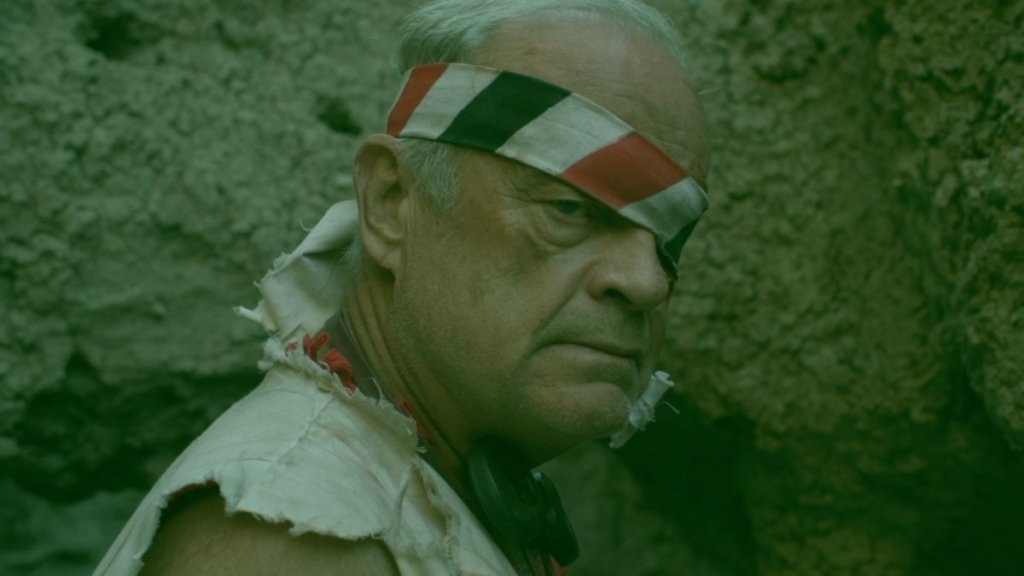
Kelsey Grammer stars in Gary Walkow’s new sci-fi movie Lars Shrike Walks the Night, which is out this week. The six-time Emmy winner spoke with ComingSoon’s Tyler Treese and discussed his latest film role, the movie’s unique meta approach to sci-fi, and teased Avengers: Doomsday. Lars Shrike Walks the Night is out July 24 on Digital from Filmhub and Vortex.
“Lars Shrike knows only two things: his name, and that he has escaped. Alone in a hostile desert landscape, he struggles to piece together who he is, where he came from, and what exactly he has fled. As fragments of memory, hallucination, and reality begin to blur, Shrike is pulled into an increasingly strange odyssey where every answer only deepens the mystery. Is he a prisoner on the run, a damaged mind inventing its own mythology, or a fictional character who has somehow stepped into the real world?” says the official synopsis.
Tyler Treese: Kelsey, congrats on Lars Shrike Walks the Night. This is such an interesting meta film. Before you took this role, did you go back and watch The Trouble with Dick? Because this is very much in conversation with that film.
Kelsey Grammer: No, I didn’t. Gary’s an old friend. I was not aware that he’d done The Trouble with Dick. He explained it to me later, once we were in the trenches with it.
I’m one of those—I don’t believe in checking out a lot of stuff. For instance, if I was playing Paris in the Troy movie, I would check out what his story was. I’d go to the library and find out what the story of Paris was. Because I did play Paris once in a play called Troilus and Cressida at the Shakespeare Festival in San Diego, I know where he comes from and why he was raised by wolves and all sorts of stuff. His name means wallet. I remember this stuff, but that’s just grist for the mill.
When it comes down to actually performing something, none of that stuff matters. It matters that you’re available and open, and people can understand you and hear you. That’s what you have to be able to do.
I loved this character off the page, so I didn’t really know anything else about it. I just liked that he’s a literal guy. He’s Lars Shrike. He’s walking the night. What is he walking the night for? He’s trying to figure out what the hell he’s here for, what that’s all about, who he is, and why he’s here. What is the reason for it? What’s his destiny? Where does he come from?
There are all sorts of wonderful things he encounters on his way. There’s a magical kind of journey, not unlike The Odyssey. It’s just without a big budget. He’s a remarkable everyman who’s facing all the things we all face every time he wakes up, every time he gets warm enough behind a rock or covered by something to take a moment to look at the sky and wonder what the hell’s going on.
It’s a great performance—I mean, it’s a great film, I think. Whether or not I’m great in it, who knows? But I loved the challenge of it, and I liked the result.
I think you gave a great performance, in my opinion. I thought this was so interesting because, as you mentioned, he’s very literal. You’re seeing a can of soda for the first time, and you’re like, “Ah, drinking cylinders. Clever.” You’re interacting with all these things that are very common in our universe, like a fork, and they’re completely alien to you. How did you find that minutiae in your performance?
I found it really wonderful. It was just like being a kid, honestly. The literal energy of this guy—everything is the first time. Everything.
A girl leans in to kiss him, and he’s got a split lip. It hurts. There are just wonderful things about it. Then he realizes, “Oh, that’s what we’re doing.”
Everything becomes what’s next. He goes from step to step and finds little pieces of information from other people, but mostly it’s the environment around him that feeds his next steps. He thinks, “I’ve got to go here. I’ve got to go there. I’ve got to do this.” Then he gets an address and thinks, “I’m going to go check that out.”
I just love his journey, and I love his open-mindedness to it all. This discovery at the end of the film, when he’s thinking about, “What have I learned?” In the end, it’s that we’re glad we’re here. No matter what it is, we’re still glad we’re alive. It’s an amazing thing.
You’re so used to playing roles like Frasier, where you’re the smartest guy. Here, you know absolutely nothing. Is that fulfilling, getting to play outside your normal type and your comfort zone?
Yeah. As an actor, you want to spend your life doing different roles rather than the same one. I was very happy to repeat and do Frasier for as long as I did, and I kept searching for other roles that would serve my own whatever that is—the hairpin in me that wants to try a different thing or create something that’s believable in a different set of circumstances.
I never quit on that. I’m just an actor. I like being an actor. I like going into different roles and putting myself into a different world if I can. Lars Shrike Walks the Night—there I am.
It’s a wonderfully rewarding opportunity I’ve had in my life because I keep looking for the thing that people don’t expect me to do.
Gary’s such an interesting writer. One of my favorite parts of the film is when you get asked if you’re glad you exist, and you initially say, “I have mixed feelings.” That got a good laugh out of me. Can you speak to the joy of Gary’s dialogue and crafting these really unique scenes for you to act out?
Kelsey Grammer: He’s a terrific writer. He’s got a wonderful brain and a wonderful way of taking what he sees and making it seeable on paper. That’s a very particular gift. Very few people actually have that gift.
He’s able to shoot what is written. He’s able to communicate what he wants to shoot to the actor, meaning me. We had a great relationship while we were shooting, where I said, “Look, you’ve got to shoot the first take.” A lot of directors don’t want to do that, but in this case, because it was such an important part of the characterization that he is seeing it for the first time, I said, “You’re going to capture some stuff that we wouldn’t otherwise capture.”
There is a thing that happens when it’s the very first time, and there’s a piece of equipment that can capture almost everything as subtly as a lens does that you won’t be able to repeat. You can get close. You can do a facsimile of it. But if you can capture that first take and see that genuine surprise, that genuine interaction with something he’s never seen before, that’s gold.
I think we have several moments in the movie that are like that. Of course, when you change the camera angle and stuff like that, you’ve got to be repeatable and pretend it’s spontaneous. But that first piece, that first time, the interaction with what’s going on in the film and what the camera is capturing, is really valuable to try to get upfront.
Gary embraced that. He had such a clear picture of where he was going. It was really great. He would set me into a scene, freezing cold, with rocks and an unbelievable, forbidding landscape all around, and then say, “Action.” It was great.
Narratively, it’s very interesting because it plays with the format a lot. There’s so much self-narration. Early on, there’s a scene where you’re thinking of different ways this interaction with a woman could go, and we’re seeing them play out differently. They’re all fantasy. What did you like most about that meta-contextual aspect of the film?
I loved the fact that he gave visual representation to the possibilities the guy was thinking. His imagination was suddenly pictured, so his monologue was actually part of the display of what we were seeing. It was part of the action of the film.
Whether or not it was true didn’t matter. It looked true for that moment because that’s how we are. We imagine things. We don’t question if they exist while we’re laying out the points, while the drama is unfolding. It’s only after the fact that we realize, “Ah, it’s bullshit,” or whatever it is we’re going to realize.
It’s, “Gee, I wish that could happen,” or, “I wish that—no, I’d rather go over here.” All that doesn’t matter in that one moment. That’s the truth. What you’re seeing is the truth in that moment, when you find out it isn’t.
One of the most impressive parts of your performance is that you play Lars Shrike as this very sympathetic person while also being constantly pretty ridiculous with how you’re interacting with these objects. As you said, he is like a newborn, in a sense, where this is his first time interacting with the world. How was finding that balance and straddling that line? I think it would be so easy for this to be off and for the film not to work at all, but you found the right balance.
Thanks. That’s kind of you. It was rewarding to play because he remained true to his desire to know more, and the universe around him kept unfolding. It kept giving him something that would pull him in one direction or another, and his decision was to simply go with it.
Because I’m on a search for, “What do I mean? What am I doing? Why am I walking in the night? Why is this happening? Where am I going?” Then, all of a sudden, a destination appears, or a human being points him in a direction and he thinks, “Well, I’ll try that,” or he falls through a window of some strange home he’s never seen.
Everything guides him to the next step, and you just have to surrender to it. So he surrenders to it, gathers information as he goes, and then finally has a moment where he can reflect on what he’s learned.
It’s wonderful. I really liked it. When I read it, I really liked it. I said to Gary, “I had something I wanted to play.”
In the final act of this film, you share so many interesting scenes with David Clennon. He’s no stranger to sci-fi, having been in The Thing. I like that while this film doesn’t have a ton of action — there’s no wild sci-fi shooting or anything like that — it still builds to this really satisfying conclusion, where that intellectual conversation at the end is just as fulfilling as if this film had led up to a big fight. How was it working with David and making sure those scenes had the gravitas of ending the film?
He’s a lovely actor. He’s rooted. He’s grounded. He’s doing the same thing. You’re playing with each other. You’re just discovering. Acting is reacting.
This guy said that. I’ll have this. My character has the idea of, “Who am I? What do you know about that? Why do you know who I am? Why are you involved in what my destiny may be?” Those are great questions, and David’s a terrific actor.
He was almost as innocent as I was because it was just as big a surprise for him to see me as it was for me to see him. That’s what I really liked—those moments and what they came to together. It’s great.
It’s funny that you have something like this, which makes the absolute most out of a small budget, and then an Avengers movie, which has a seemingly unlimited budget, coming out the same year. Can you speak to your love of acting and being happy to make the most out of this small, interesting project just the same as the biggest film of the year, which you’re also in?
Kelsey Grammer: That’s fun, isn’t it? That’s a pinch-me thing for an actor. You just go, “Okay. I’ve been given the grace by God or whatever to have a chance to work this stuff out in different ways.”
I suffered to shoot Lars Shrike Walks the Night. I actually suffered. In Avengers, it looks like we’re suffering, but we’re not. We’re living in a great place in London, and you drive out in a limousine. Somebody will take you to the set, and you throw on a costume. It’s almost like being in the lap of luxury, and you go out and pretend you’re in hell.
I was in hell when I did Lars Shrike Walks the Night because that’s all we had the money for. We could find hell and stick me in it in a prisoner outfit. It was really fun, though. They’re always fun. It’s remarkable. In the end, we’re always looking for some sort of universal truth, I think. Some reason to go on, to continue, to love why we’re here, and to love it while we’re here. I think all acting work is meant for that.
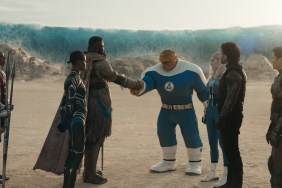
The big Doomsday trailer also released today. Are you glad that the veil of secrecy is starting to be lifted a little bit? That has to be so awkward to always have to talk about it.
Kelsey Grammer: We’re not really allowed to talk about it. I can say Beast has always been my favorite character. I love him. I’ve loved him since the moment I was asked to play him the first time. That’s 20-plus years now.
I think he’s fantastic. I would play him forever. I would love to do another five or six movies with Beast. Whether or not that’s in the cards is not up to me or anything else. I don’t even know how this one ends. That’s just the way it is. I’m sticking with that. I sure do like playing him. I hope people enjoy watching it.
You were just in Young Washington, which I really enjoyed. What was most fulfilling about that experience of playing Thomas Fairfax? He has such an important role in getting General Washington’s start.
Kelsey Grammer: Kicking him off. He started the whole mechanism.
Fairfax was a fun character to play because, when you play Englishmen, you always wonder, “Why the hell was he in America?” Lords come from families that are well-established and have been there for a thousand years. Usually, a guy who ended up in a colony somewhere was probably the third or fourth son. There was no way he was ever going to inherit anything.
He probably became a pretty self-made man in America, being the largest landowner in the colonies at the time. That made him fun to play. The spirit of finding something in somebody else that might be the defining factor in him, the one that says, “You’re going to go far.” I think that was implied in the scene I did with the young George Washington, with William. He’s terrific.
I’m a big American history fan. I love it, and I’ll go to the mat anytime, swinging for the Founding Fathers. When we got to do the George Washington story, they called me. I flew over to Ireland to do it, and I said, “Tell me you’re doing the scene about the bullets.”
I know about the bullets, the doublet and the greatcoat that had 50 holes in it, and nobody got him. This is real. George Washington was untouchable in that battle. That’s remarkable. They said, “Yeah, I’m doing it.” I’m glad they did it.
That’s a great moment in the film. I like how you play that character, too, because when you think of a lord of a big manor like Fairfax, you think he’d be uptight, but you’re actually cool with him sneaking into the party. There’s a nice humanity to that. Especially with these historical figures who seem so larger than life, it’s hard to imagine them as actual people. I really liked the small touches you found there.
Other than George Washington, I think the key is that we learn our Founding Fathers are actually the same size we are. Other than George Washington. I would say the monument on the Mall in Washington, D.C., is just not big enough. He’s that remarkable. But most of these other guys are our size. They have the same passions we have.
We’ve just lost touch with that. That’s a good journey, to try to remember that.
All these other guys would have gotten shot a few times in that battle.
Most of them would be dead.
Thanks to Kelsey Grammer for taking the time to talk about Lars Shrike Walks the Night.