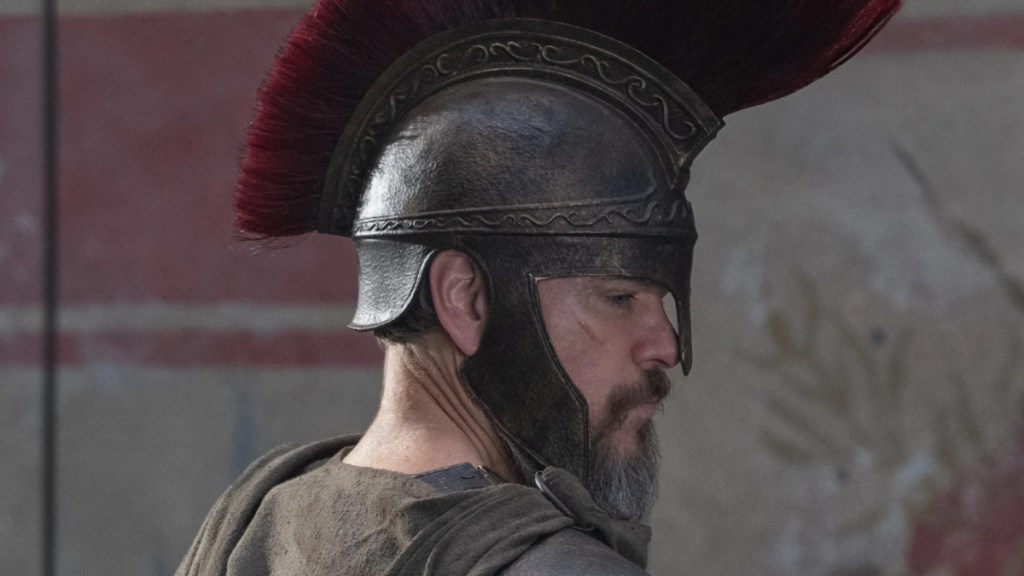
Christopher Nolan made some bold choices when adapting one of history’s most famous stories for the big screen. Here’s a breakdown of the biggest changes between The Odyssey film and Homer‘s original epic poem.
How Christopher Nolan’s The Odyssey changes things from Homer’s original
Christopher Nolan’s The Odyssey makes several significant changes from Homer’s ancient epic poem.
The film almost completely removes Odysseus the trickster from the story. Instead, Matt Damon plays a guilt-ridden hero suffering PTSD flashbacks from Troy’s sacking. Nolan also cuts the Phaeacians entirely and removes the narrative frame of Odysseus recounting his adventures. The film adds Sinon, a character from Virgil’s Aeneid who never appears in Homer’s poem.
Nolan reimagines several key mythical encounters throughout the seafaring voyage. Charlize Theron’s Calypso becomes a sympathetic figure who gives Odysseus lotus flowers to ease trauma. Homer’s Calypso instead holds Odysseus captive for seven years and promises him immortality. The Cyclops Polyphemus loses his famous “Nobody” trick and his cycloptic companions in the film. Nolan also transforms Circe from a seductress into an earthy sorceress demonstrating men’s greedy nature.
The film introduces contemporary themes absent from Homer’s original text. Nolan adds anxiety about “people from the sea” invading territories, which never overtly appears in Homer. His adaptation weaves in concerns about immigration, military aggression, and collapsing empires. The Sirens now reveal that Odysseus secretly does not want to return home at all.
Nolan significantly softens the poem’s most brutal elements in the final act. Homer orders 12 slave girls hanged after cleaning the suitors’ blood. The film reduces this to one treacherous handmaid, Melantho, whose fate Penelope seals instead. Nolan also removes celestial scenes showing gods colluding for or against human subjects.
The ending diverges most dramatically from Homer’s conclusion. Homer reunites Odysseus with his elderly father, Laertes, in the poem’s final books. Nolan removes Laertes entirely and instead positions Telemachus as the generational successor to the throne. This shifts the story from a father-son reunion into a meditation on the older generation’s failure through war.
Nolan’s Odysseus instead sails west to honor his fallen men with Penelope beside him. The film leaves it unclear whether this voyage happens or if it represents his passage into death.
(via Vanity Fair)